If you’re preparing for the AI specialist Certification Salesforce (also known as the Agentforce Specialist certification), you already know that practice questions are your secret weapon. But here’s what most study guides won’t tell you: not all practice questions are created equal.
I’ve spent the last few months diving deep into this certification, talking to people who’ve passed (and failed), and analyzing hundreds of practice questions. What I learned completely changed how I approached my own exam prep—and it’s what I’m about to share with you.
If you’re preparing for the AI Specialist certification as part of a broader Salesforce career path, the Salesforce Interview Questions: The Complete Preparation Guide for Every Salesforce Role is a powerful companion resource. Many of the scenario-based concepts in this exam align closely with what hiring managers ask during real Salesforce interviews—especially around data usage, automation logic, and solution design. Using this guide alongside your certification prep not only strengthens your technical understanding but also sharpens the way you articulate solutions, a skill that’s invaluable both in the exam and in job interviews.
Table of Contents
ToggleWhy Practice Questions in AI specialist Certification Salesforce Matter More Than You Think
Let me be blunt: you’re not going to pass the AI Specialist certification by just reading documentation and watching videos.
I know that sounds harsh, but it’s true. This exam is different from other Salesforce certifications. It’s not testing whether you can recite field names or remember which object relates to which. It’s testing whether you can apply AI concepts in real-world scenarios.
And the only way to get good at application-level thinking? Practice questions. Lots of them.
Here's what happened to me:
When I first started studying, I spent two weeks reading through all the Trailhead modules. I felt confident. I understood prompt engineering, I knew what Einstein Copilot could do, I could explain the difference between standard and custom models.
Then I took my first practice exam and scored 62%.
Not even close to the 73% passing score.
The problem? I was great at knowing things but terrible at applying them. Practice questions taught me how to think like the exam thinks.
Understanding the AI Specialist Exam
As you work through the AI Specialist material, it becomes clear how critical data grounding and real-time context are to building effective AI solutions. That’s why the resource How Agentforce Works with Data Cloud for Better Efficiency and Helps Customers and Businesses is so valuable. It breaks down how Agentforce leverages Data Cloud to provide richer, more accurate AI responses—exactly the kind of logic the exam expects you to understand. Seeing how Data Cloud fuels intelligent workflows will help you grasp why grounding, prompt engineering, and model selection matter so much in real implementations.
Before we dive into practice questions, let’s make sure we’re on the same page about what this exam actually tests.
The Basics
- 60 questions (multiple choice and multiple select)
- 105 minutes to complete
- 73% passing score (you need 44 correct answers)
What Makes This Exam Different
Unlike traditional Salesforce certs that test configuration knowledge, the AI Specialist exam is all about scenarios. You’ll see questions like:
“A marketing team wants to generate personalized emails using customer purchase history. Which approach should they use?”
You need to evaluate the business context, understand the technical options, and choose the best solution. Not just a solution that works, but the best one for that specific scenario.
To fully appreciate why the AI Specialist exam emphasizes real-world scenarios, it helps to understand where Salesforce is heading. The article Agentforce Customer Support Evolution in 2026 gives a forward-looking view of how AI-driven support is transforming service operations. It highlights the shift from traditional case management to proactive, conversational, and autonomous support experiences—exactly the environment that Agentforce specialists are expected to work within. Reading this provides context for why Copilot actions, model grounding, and prompt precision are so important on the exam.
That’s where practice questions become crucial.
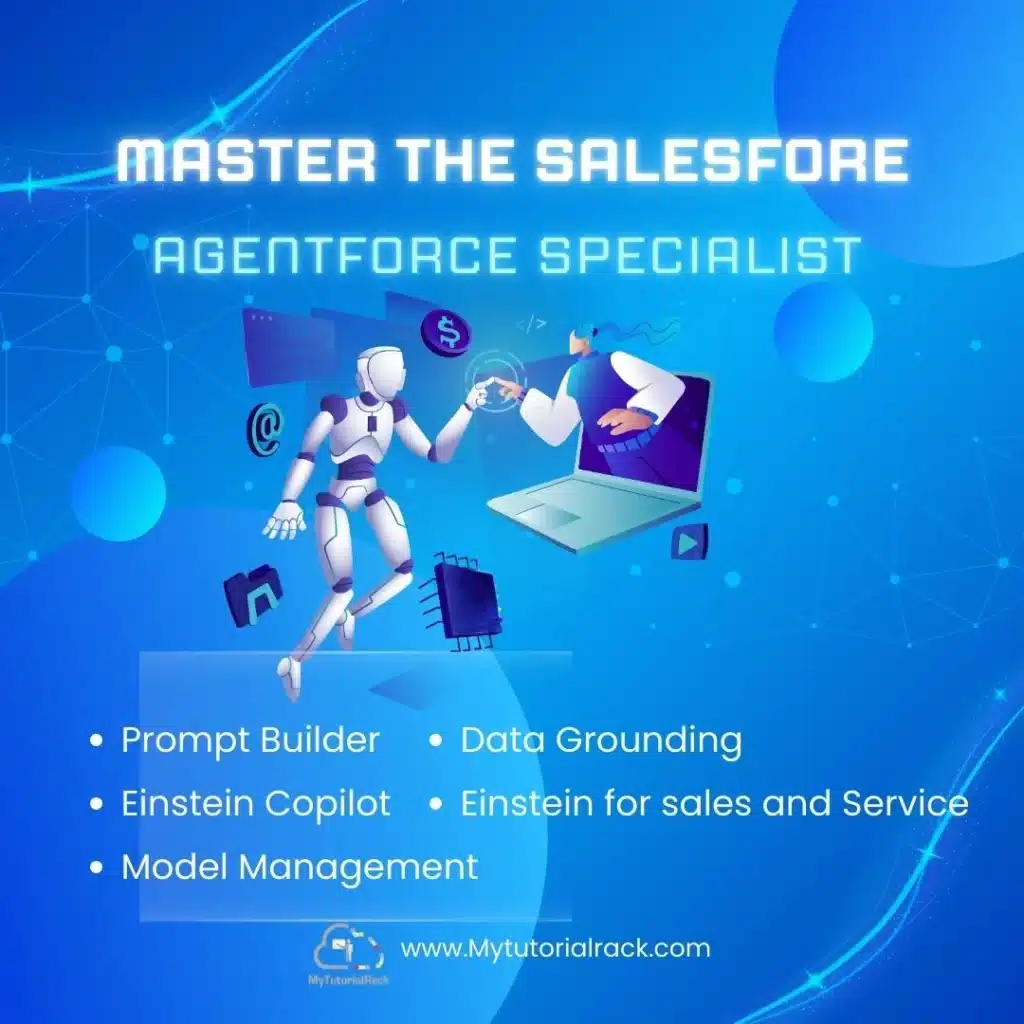
The 5 Categories AI specialist Certification Salesforce You Need to Master
Based on analyzing hundreds of AI Specialist certification Salesforce practice questions, I’ve identified five critical categories that come up repeatedly on the exam:
A major theme in the AI Specialist certification is understanding how humans and AI work together—not just how the technology works alone. The resource How Agentforce Will Redefine Human + AI Collaboration dives into this emerging dynamic with clarity. It explains how AI agents, copilots, and human experts coordinate to deliver better outcomes, reduce workload, and enhance decision-making. This perspective helps you see beyond the mechanics of prompts and actions and understand the bigger picture of AI-assisted workflows—an essential mindset for both the exam and real-world execution.
1. Prompt Engineering & Prompt Builder
This is HUGE on the exam. Expect 15-20 questions focused on when to use Prompt Builder, how to configure prompts, and what makes a good prompt.
Key Concepts:
- When Prompt Builder is the right tool vs. when it’s not
- How to structure effective prompts
- Field generation and dynamic content
- Grounding techniques for accuracy
Example Practice Question:
A sales team wants to automatically generate follow-up emails based on meeting notes stored in Salesforce. Should they use Prompt Builder?
A. No, because email generation requires custom coding
B. Yes, because Prompt Builder can access Salesforce data to personalize emails
C. No, because Prompt Builder only works with static templates
D. Yes, but only for internal emails, not customer-facing ones
Answer: B – Prompt Builder is designed exactly for this use case. It can access Salesforce data (like meeting notes) and generate personalized content based on that data.
See how that works? The question isn’t asking “what is Prompt Builder?”—it’s asking “should you use it in this specific situation?”
2. Einstein Copilot & Copilot Actions
Einstein Copilot is Salesforce’s AI assistant, and understanding how it works is critical.
Key Concepts:
- Standard vs. custom copilot actions
- When to create custom actions
- How the Large Language Model (LLM) interprets requests
- Managing copilot adoption
Example Practice Question:
When is it most appropriate to create a custom copilot action?
A. When automating a common task across all industries
B. When a specific business process requires unique data inputs and custom logic
C. When using Salesforce’s default functionalities
D. When generating standard reports
Answer: B – Custom actions are for unique business processes that standard actions can’t handle. If your process requires specific data inputs or custom logic, you need a custom action.
3. Model Configuration & Management
This section covers when to use standard models, custom models, or bring your own LLM (BYOLLM).
Key Concepts:
- Standard generative models (out-of-the-box)
- Custom generative models (when you need specialization)
- BYOLLM (when you need complete control)
- Model Builder use cases
Example Practice Question:
A retail company needs highly tailored product descriptions with full control over the model’s behavior. Which option should they choose?
A. Standard generative model
B. Custom generative model within Salesforce
C. Bring Your Own Large Language Model (BYOLLM)
D. Third-party service
Answer: C – When you need “full control” and “highly tailored” outputs, BYOLLM is the answer. Standard and custom models within Salesforce have limitations on control.
4. Data Grounding & Integration
This is where many people struggle. Understanding how to ground AI responses in real data is crucial.
Key Concepts:
- Grounding techniques (using real CRM data)
- Real-time vs. static data
- Data Cloud integration
- Retrieval methods
Example Practice Question:
A sales team wants AI-generated emails based on the most recent customer interactions. Which grounding technique should they use?
A. Static text templates
B. Historical sales reports
C. Real-time CRM data integration
D. External social media data
Answer: C – “Most recent” is the key word. Real-time CRM data integration ensures the AI uses current, relevant information.
5. Einstein for Service & Sales Features
You need to know specific Einstein features and when to use them.
Key Concepts:
- Einstein Case Wrap-Up
- Einstein Forecasting
- Einstein Activity Capture
- Einstein Bot
- Einstein Lead Scoring
Example Practice Question:
Customer service agents need AI-generated summaries after resolving cases. Which feature should they use?
A. Einstein Reply Recommendations
B. Einstein Case Wrap-Up
C. Einstein Case Classification
D. Einstein Next Best Action
Answer: B – Einstein Case Wrap-Up generates summaries after case resolution. The other features serve different purposes.
25 Essential AI Specialist Certification Practice Questions
Now let’s get into actual practice. I’ve compiled 25 questions that represent the types of scenarios you’ll see on the real exam.
If you want to understand the deeper vision behind Einstein Copilot and Agentforce orchestration, the AgentForce 360 and the Agentic Revolution — Dreamforce 2026 Unveiled article is a must-read. It explores how Salesforce is moving toward fully agentic systems—where AI doesn’t just answer questions but takes smart, autonomous actions. This aligns directly with Copilot actions, LLM interpretation, and multi-step automation scenarios covered in the exam. Studying this helps you see how your technical skills fit into Salesforce’s long-term roadmap for intelligent, action-driven AI.
Prompt Builder Questions
Question 1: An HR team needs to create personalized onboarding materials for new employees across different departments. Should they use Prompt Builder?
A. Yes, because Prompt Builder can generate consistent and customized materials
B. No, because onboarding requires a personal touch AI cannot provide
C. Yes, but only for generic content, not personalized sections
D. No, because Prompt Builder is only for customer-facing content
Answer: A – Prompt Builder excels at generating consistent, customized content based on templates, making it perfect for department-specific onboarding materials.
Question 2: When configuring prompts, what is the most important consideration for ensuring accurate outputs?
A. Making prompts as long as possible
B. Grounding prompts in relevant, up-to-date data
C. Using only static templates
D. Avoiding field generation
Answer: B – Grounding in relevant data is crucial for accuracy. Without proper grounding, AI generates generic or incorrect responses.
Question 3: A company wants to generate product descriptions using Salesforce data. What should they configure first?
A. Import all customer data
B. Select a standard generative model
C. Develop custom ML algorithms
D. Connect to external AI services
Answer: B – Start with Salesforce’s standard generative model, which is pre-trained and ready for configuration.
Einstein Copilot Questions
Question 4: How does Einstein Copilot determine which action to take when a user requests a sales report?
A. By analyzing the user’s tone
B. By recognizing keywords and phrases related to sales reports
C. By executing the most frequently used command
D. By sending the query to a human supervisor
Answer: B – The LLM identifies actions by recognizing specific keywords and phrases associated with predefined actions.
Question 5: When should you create a custom copilot action?
A. For automating common cross-industry tasks
B. When a business process needs unique data inputs and custom logic
C. For using default Salesforce functionalities
D. For generating standard reports
Answer: B – Custom actions are necessary when standard actions can’t handle your specific business process requirements.
Question 6: A company rolled out Einstein Copilot but sees low adoption. What's the best way to identify barriers?
A. Implement surveys to collect user feedback
B. Schedule daily meetings about Copilot usage
C. Mandate Copilot use without exceptions
D. Review only successful use cases
Answer: A – Surveys directly capture user challenges and barriers, providing actionable insights for improvement.
Model Configuration Questions
Question 7: When should a company configure a custom generative model?
A. For basic customer inquiries
B. When they need to handle company-specific technical terminology
C. When using only public domain data
D. With limited datasets and no customization needs
Answer: B – Custom models are appropriate when you need to integrate highly specific, proprietary language that standard models don’t cover.
Question 8: What's the primary consideration when configuring a BYOLLM in Salesforce?
A. Pre-training on Salesforce-specific data
B. API standard compliance
C. Deployment on Salesforce-compatible infrastructure
D. High number of parameters
Answer: C – Infrastructure compatibility is crucial for seamless integration and performance within Salesforce.
Question 9: What's the first step in configuring a standard generative model for personalized emails?
A. Import the entire customer database
B. Select the standard generative model in Salesforce
C. Develop custom algorithms
D. Connect to external AI services
Answer: B – Select the pre-trained standard model that’s ready for configuration out of the box.
Data Grounding Questions
Question 10: How should you ground AI responses to ensure they're based on recent customer interactions?
A. Static text templates
B. Historical sales reports
C. Real-time CRM data integration
D. External social media data
Answer: C – Real-time CRM data ensures AI uses the most current, relevant customer information.
Question 11: A company wants to ensure sensitive salary data isn't processed by Einstein. What should they use?
A. Field-Level Security
B. Einstein Data Exclusion
C. Salesforce Shield Encryption
D. Remove salary fields from the schema
Answer: B – Einstein Data Exclusion specifically prevents certain fields from being processed by Einstein analytics.
Question 12: When should a company use Model Builder?
A. For manually reviewing applications
B. For calculating using standard formulas
C. For developing predictive models (like loan default prediction)
D. For sending automated emails
Answer: C – Model Builder is designed for creating predictive models that assess outcomes based on data analysis.
Einstein Features Questions
Question 13: Agents need AI-generated case summaries after resolution. Which feature should they use?
A. Einstein Reply Recommendations
B. Einstein Case Wrap-Up
C. Einstein Case Classification
D. Einstein Next Best Action
Answer: B – Einstein Case Wrap-Up generates summaries of case details after resolution.
Question 14: A service center wants to provide 24/7 answers to common questions. What should they implement?
A. Einstein Case Classification
B. Einstein Bot
C. Einstein Article Recommendations
D. Einstein Next Best Action
Answer: B – Einstein Bot automates customer interactions, providing instant answers without requiring agents.
Question 15: A sales director wants to project next quarter's revenue using AI. Which feature should they use?
A. Einstein Lead Scoring
B. Einstein GPT for Sales Predictions
C. Einstein Opportunity Insights
D. Einstein Forecasting
Answer: D – Einstein Forecasting predicts future sales performance using historical trends and pipeline data.
Question 16: A sales manager wants to automatically log all client interactions. Which feature should they use?
A. Einstein Opportunity Scoring
B. Einstein Activity Capture
C. Einstein Next Best Action
D. Einstein Email Insights
Answer: B – Einstein Activity Capture automatically logs emails and meetings into the CRM.
User Roles & Template Management Questions
Question 17: Which role should execute predefined prompt templates without modifying them?
A. Content Creator
B. Salesforce Developer
C. Prompt Executor
D. System Administrator
Answer: C – Prompt Executor is designed specifically to execute templates without modification permissions.
Question 18: Which role should manage and maintain prompt templates organization-wide?
A. Sales Representative
B. Marketing Manager
C. System Administrator
D. Customer Service Agent
Answer: C – System Administrators have the access and knowledge to manage system-wide template configurations.
Question 19: What's the final step after creating and activating a prompt template?
A. Run training for all users
B. Execute the template in relevant Salesforce processes
C. Send notification to management
D. Archive for future reference
Answer: B – Execution within processes ensures the template generates intended outputs.
Adoption & Monitoring Questions
Question 20: What's the best way to track Einstein Copilot adoption among agents?
A. Analyze Copilot action frequency using Salesforce dashboards
B. Conduct weekly surveys
C. Set monthly targets and penalize agents
D. Manually track by observing workflows
Answer: A – Dashboards provide data-driven insights into actual usage patterns objectively.
Question 21: What should be the primary focus when managing Copilot adoption across departments?
A. Ensuring equal usage across all departments
B. Providing targeted training based on department-specific use cases
C. Monitoring system performance
D. Forcing all employees to use Copilot
Answer: B – Targeted, department-specific training ensures Copilot delivers value in context-appropriate ways.
Question 22: How do you link Copilot usage to business outcomes?
A. Compare departments using vs. not using Copilot
B. Focus only on qualitative feedback
C. Integrate usage data with business performance dashboards
D. Evaluate impact after a year
Answer: C – Dashboard integration allows correlation between Copilot usage and key business metrics.
Advanced Scenario Questions
Question 23: A financial services company needs to assess loan default risk. What should they use?
A. Manual credit history reviews
B. Standard interest rate formulas
C. Model Builder to predict default likelihood
D. Automated approval emails
Answer: C – Model Builder creates predictive models to assess outcomes like loan defaults.
Question 24: When creating templates for multiple departments, what's the key consideration?
A. Incorporating department-specific terminology
B. Keeping templates as general as possible
C. Limiting to predefined outputs
D. Ensuring all users can modify them
Answer: A – Department-specific terminology ensures relevance and effectiveness across different use cases
Question 25: A team needs to monitor AI-generated content quality. What's crucial for Model Builder configuration?
A. Selecting right pre-training data
B. Choosing highest number of layers
C. Integrating with CRM data only
D. Prioritizing performance over accuracy
Answer: A – Pre-training data quality and relevance significantly impact model effectiveness.
Where to Find Quality AI Specialist Certification Practice Questions
If you want a structured approach with hundreds of practice questions, detailed explanations, and expert support, our Agentforce Specialist Certification Course includes a complete question bank designed specifically for exam success.
Final Thoughts
Here’s what I wish someone had told me when I started studying:
Practice questions aren’t just about testing yourself. They’re about teaching yourself to think like the exam thinks.
The AI Specialist certification is challenging, but it’s passable. With the right practice questions and the right approach, you can absolutely do this.
Focus on understanding concepts deeply. Practice under real conditions. Review your mistakes thoroughly. And don’t just memorize—actually learn.
The market for AI specialists is exploding. Companies are desperate for people who can implement Agentforce and Einstein AI effectively. This certification can be your ticket to better opportunities and better pay.
So get those AI Specialist certification practice questions in front of you and start practicing. Your future self will thank you.
Ready to dive deeper? Drop a comment below with your biggest challenge in studying for this exam—I read and respond to every one.
Related Resources:
- Official Salesforce AI Specialist Exam Guide
- Trailhead: Salesforce AI Specialist Certification Prep
- Drive Productivity with Einstein AI Trail
- Comprehensive Agentforce Specialist Certification Course