If you’ve been following Salesforce news lately, you’ve heard the buzz around Agentforce 360 — but between the marketing hype and the technical jargon, it’s hard to know what actually matters for someone building a career in the Salesforce ecosystem right now.
Here’s the honest answer: this is not just a product rebrand or a shiny AI feature release. Agentforce 360 is a fundamental repositioning of what Salesforce is — and understanding it now could be the single most important career move you make in 2026.
Let’s break it down clearly, practically, and with real context that most blogs simply miss.
Table of Contents
ToggleWhat Is Agentforce 360? (And Why the Name Change Actually Matters)
Most of us grew up in the Salesforce world thinking of the platform as a CRM — a place to store leads, manage pipelines, and run reports. Even the old “Customer 360” branding reinforced that idea: one unified view of the customer.
Agentforce 360 changes the paradigm entirely.
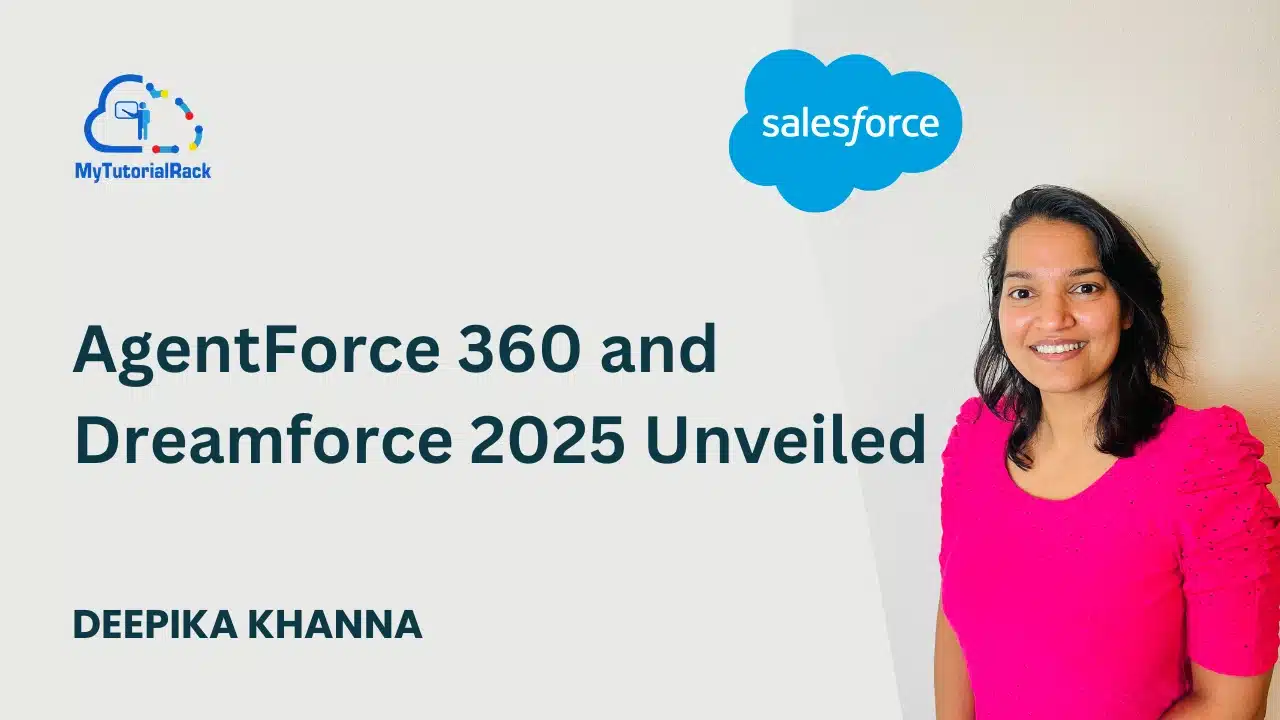
Announced at Dreamforce 2025, Agentforce 360 is Salesforce’s unified platform that connects four core elements:
- Agentforce 360 Platform — the engine for building, deploying, and governing AI agents
- Data 360 (the rebranded Data Cloud) — the trusted, real-time data layer that gives agents context
- Customer 360 Apps — Sales, Service, Marketing, Commerce, and Industry Clouds, now AI-native
- Slack — the human-agent collaboration layer, where people and agents work together in real time
Think of it like this: if the old Salesforce was a filing cabinet that got smarter over time, Agentforce 360 is a team of specialized co-workers who can read every file in that cabinet, make decisions, and take action — all while checking in with you when something needs human judgment.
The name shift from “Salesforce Platform” to “Agentforce 360 Platform” isn’t just marketing. It signals that the agent layer is now the primary interface through which businesses interact with data and customers — not forms, not dashboards, but autonomous AI actions.
The Four Building Blocks of Agentforce 360 (What You'll Actually Work With)

1. Agentforce Builder: Low-Code Agent Development Has Arrived
One of the most underappreciated announcements in the Agentforce 360 release is the new Agentforce Builder — a conversational development studio where you can design, test, and deploy agents using natural language.
This is a big deal for beginners and intermediate professionals alike.
But here’s the insider insight most blogs skip: the Builder doesn’t eliminate technical skills — it elevates them. The unified workspace collapses the build-test-deploy loop into a single interface with live debugging, trace views of every reasoning step, and multi-view editing (doc-like, canvas, or script). Skilled developers who learn to use Agentforce Builder effectively will be dramatically faster than those who don’t.
For Admins: Think of Builder like a smarter version of Flow Builder — you’re still the architect, but you now have an AI assistant helping you wire up the logic.
For Developers: The pro-code path still exists through Apex and JavaScript. What’s new is Agentforce Vibes — an AI coding partner that operates like a pair programmer inside your IDE, understands your Salesforce project context, and executes development tasks on your behalf.
2. Agent Script: The Missing Layer Between Prompts and Business Logic
Most AI platforms force you to choose between two extremes: fully flexible LLM responses (creative but unpredictable) or rigid, rule-based automation (predictable but brittle).
Agent Script is Agentforce 360’s answer to this false choice.
It’s a human-readable, portable JSON expression language that lets you define complex agent behavior with conditional logic, if/then rules, and precise tool use — all while still leveraging LLM reasoning where flexibility is needed. This is what Salesforce calls Hybrid Reasoning through the Atlas Reasoning Engine.
In practice, this means you can define guardrails like: “If the customer is on a premium plan and the issue is billing-related, always escalate to a human agent after two failed resolution attempts.” That level of control is what enterprise clients actually need — and it’s what makes Agentforce 360 deployable in regulated industries like financial services and healthcare.
Career relevance: Professionals who understand Agent Script and Hybrid Reasoning will be able to talk to enterprise clients about governance and compliance — a conversation that goes way beyond typical admin or developer responsibilities.
3. Agentforce Voice: The Phone Channel Finally Gets Intelligent
Here’s a statistic that should get your attention: roughly 80% of all customer service inquiries still begin over the phone.
For years, Salesforce excelled at digital and web-based customer interactions, but the phone channel remained largely stuck with legacy IVR systems — the kind that make you press 1 for English and repeat yourself three times.
Agentforce Voice changes that. It delivers natural, low-latency voice conversations powered by AI, with full integration into existing contact center infrastructure (NICE, Genesys, Amazon Connect, Five9, and Vonage). Live transcription means human agents can monitor conversations in the Service Console in real time and take over instantly if needed.
More importantly for implementation professionals: Voice agents are trained on your company’s data, tone, and brand guidelines. This isn’t a generic chatbot with a microphone — it’s a fully contextual, brand-aware voice representative.
4. Data 360: Why the Data Layer Is the Real Secret Weapon
Agentforce 360 agents are only as intelligent as the data they can access. This is where Data 360 (the evolution of Data Cloud) becomes critical.
Two innovations stand out:
- Intelligent Context — allows agents to access and reason over unstructured data like PDFs, emails, and product documentation, not just structured CRM records
- Tableau Semantics — translates raw analytics data into business language that agents can actually interpret and act on
Here’s what this means in practice: an Agentforce Service Agent handling a warranty claim can now read the actual product manual, cross-reference the customer’s purchase history in CRM, check inventory availability, and draft a resolution — all before the customer finishes explaining their problem.
For consultants and architects, Data 360 is the layer where implementations succeed or fail. Getting the data model right, setting up proper governance, and ensuring clean metadata structure will determine whether your agents are genuinely useful or confidently wrong.
Agentforce 360 in Action: Real-World Implementation Scenarios
Understanding the platform is one thing. Seeing how it maps to real projects is what separates theoretical knowledge from job-ready skills.
Scenario 1 — E-Commerce Service Automation (Service Cloud + Agentforce)
A mid-size retailer wants to reduce support ticket volume. Using an out-of-the-box Service Agent on Agentforce 360, they configure the agent with their return policy documentation (via Intelligent Context), their order management data (via Data 360), and escalation rules (via Agent Script). The agent handles returns, shipping inquiries, and refund status checks autonomously — with a handoff protocol to human agents for edge cases.
Result: The kind of outcome Reddit achieved — support case deflection above 40%, with dramatically faster resolution times.
Scenario 2 — Talent Recruitment Automation (Sales Cloud + Slack)
A staffing firm uses Agentforce 360 to handle candidate screening conversations outside business hours. The SDR agent engages candidates in Slack, asks screening questions, evaluates responses against job criteria stored in CRM, and schedules interviews — all without human intervention. Recruiters wake up to a curated shortlist.
Result: The kind of 24/7 engagement Adecco reported, where 51% of candidate conversations happened outside standard working hours.
Scenario 3 — Developer Productivity (Agentforce Vibes + DevOps Center)
A Salesforce developer is building a custom LWC component for a client’s service portal. They activate Agentforce Vibes in their IDE, describe the component behavior they need, and the AI coding partner generates the scaffolding, identifies potential test scenarios, and flags metadata conflicts — in real time.
Result: The kind of development acceleration that makes a junior developer punch above their weight in a team setting.
What Most Salesforce Professionals Are Getting Wrong About Agentforce 360
Let’s address a few misconceptions that circulate in the Salesforce community.
Misconception 1: “It’s just Einstein with a rebrand.”
Einstein was a feature layer — predictions, recommendations, and generated content embedded into existing screens. Agentforce 360 is an agentic OS: agents reason, take action, collaborate with other agents, and operate across the entire enterprise. The Atlas Reasoning Engine behind Agentforce 360 now supports models from OpenAI, Anthropic, and Google Gemini — giving teams model choice and configurable reasoning depth.
Misconception 2: “Admins don’t need to worry about AI.”
If your admin skills stop at point-and-click configuration, the gap between you and the market is widening every quarter. Admins who understand how to configure Agent Topics, define guardrails in Agent Script, and set up Data 360 governance policies will be far more valuable than those who don’t.
Misconception 3: “The costs are manageable.”
This is where you need to be honest with clients and employers. Agentforce 360 pricing is consumption-based, and the full stack — core cloud subscriptions, Data Cloud consumption, Agentforce agent usage, and Slack — can add up significantly. As an implementation professional, understanding the ROI modeling and cost architecture is part of your value-add, not just the technical configuration.
Why Agentforce 360 Matters for Your Salesforce Career Right Now
Here’s the career reality check: every significant platform evolution in Salesforce’s history has created a wave of high-demand professionals — people who got ahead of the curve.
When Apex replaced S-Controls, developers who learned Apex early got the best consulting roles. When Lightning Experience replaced Classic, admins who adapted early commanded higher rates. When Flow replaced Workflow and Process Builder, flow specialists became indispensable.
Agentforce 360 is the next wave — and it’s moving faster than any of the previous ones.
The skills that will be most valued in the next 12–24 months:
- Agent configuration and governance — defining Topics, Instructions, Actions, and guardrails
- Data 360 data modeling — clean metadata, unstructured data indexing, and semantic layer configuration
- Agent Script authoring — combining deterministic logic with LLM flexibility
- Multi-agent orchestration — designing systems where agents hand off to each other and to humans
- ROI modeling for AI implementations — helping clients quantify the business case
If you’re early in your Salesforce journey, the most important thing you can do right now is build a mental model of how agents fit into the existing platform — and start getting hands-on in Trailhead and Developer Edition orgs.
How to Start Learning Agentforce 360: A Practical 4-Step Path
-
Get your core certifications solid first. Agentforce 360 is built on the existing Salesforce platform. If you haven’t done Salesforce Admin (ADM-201) or Platform Developer I, those remain the foundation. You need to understand CRM objects, data models, and automation before you can meaningfully configure agents on top of them.
-
Explore Agentforce in Trailhead. Salesforce has dedicated Agentforce trails covering Agent Builder, Topics, Actions, and Prompt Templates. Work through them with a Developer Edition org open alongside so you’re doing, not just reading.
-
Get hands-on with a use case you actually care about. Pick one scenario — maybe a service bot for a mock e-commerce company — and build it end to end. Configure the agent, connect it to sample data, write a basic Agent Script guardrail, and test it. The muscle memory from building beats any amount of passive learning.
-
Earn the Agentforce Specialist Certification. Salesforce has released a dedicated certification path for Agentforce. This credential signals to employers and clients that you understand the full agentic stack — not just the surface-level features.
The Road Ahead: Where Agentforce 360 Is Going
Agentforce 360 isn’t a finished product — it’s a platform in rapid evolution.
A few directions worth watching closely:
- Agent-to-Agent (A2A) protocols — the emerging standard for how different AI agents from different vendors communicate with each other. Agentforce already supports this alongside MCP (Model Context Protocol), signaling that future enterprise AI will involve orchestrated networks of agents, not just one smart bot.
- Deeper Slack integration — Salesforce is actively working to make Slack the primary human-agent collaboration layer across the enterprise, with agents surfacing information and executing actions inside Slack channels without requiring app-switching.
- Broader industry specialization — Agentforce Life Sciences, Public Sector, and Manufacturing are early signs that vertical-specific agent configurations will become a major consulting opportunity.
- Open ecosystem on AgentExchange — similar to AppExchange, but for agents, templates, and actions. Partners who publish quality components here will gain visibility and leverage in the Salesforce ecosystem early.
Conclusion: The Agentic Era Is Already Here — Your Move
Agentforce 360 isn’t a future roadmap item or an aspirational concept. It’s already deployed across 12,000 customers, and the results being reported — support cases resolved in under two minutes, candidate conversations handled at midnight, 70% of inquiries resolved without human intervention — aren’t marketing projections. They’re production outcomes.
The question isn’t whether the Salesforce ecosystem is changing. It’s whether you’re positioning yourself to lead that change or catch up to it.
If you’re ready to move from passive learner to active practitioner, the best next step is to build hands-on skills with the agentic layer before most of your peers even know where to start.
Ready to go deeper?
If you want to build real Agentforce skills with hands-on projects — not just theory — the Salesforce Agentforce Specialist Certification course at MyTutorialRack is designed exactly for that. It covers agent configuration, Data 360 fundamentals, Agent Script logic, and real-world implementation scenarios — the kind of job-ready skills that translate directly to client projects and interviews. It’s the practical foundation I’d recommend to anyone serious about making Agentforce their career differentiator.