Table of Contents
ToggleIntroduction: Is PDI Worth It? Absolutely — Here's Why
You’ve probably heard people in the Salesforce ecosystem talk about the Platform Developer I (PDI) certification like it’s some kind of golden ticket. And honestly? They’re not wrong.
Whether you’re a fresh graduate exploring Salesforce for the first time or an Admin who’s been clicking around orgs for a couple of years, the question eventually comes up: Should I go for the Platform Developer 1 certification?
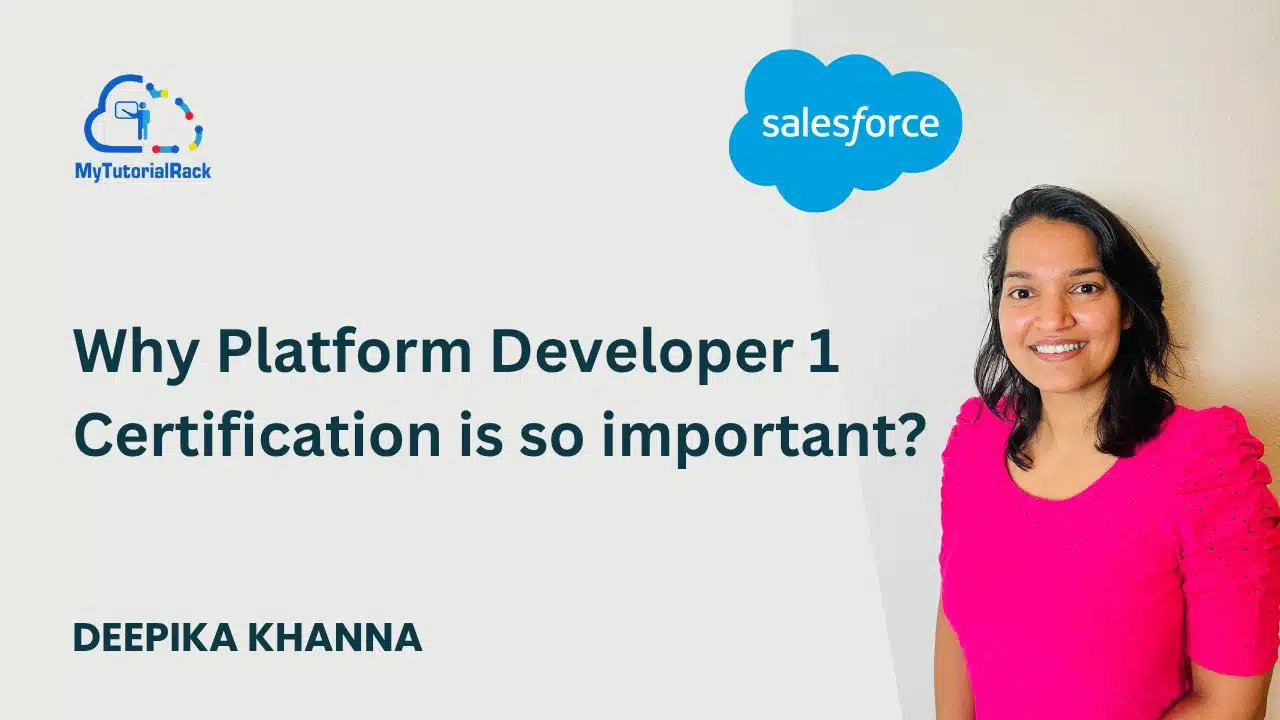
The short answer is yes — and understanding why Platform Developer 1 certification is so important could be the decision that reshapes your entire career trajectory. This post breaks down exactly what it is, what it covers, and why it matters more than ever in today’s Salesforce job market.
What Is the Salesforce Platform Developer 1 Certification?
The Salesforce Certified Platform Developer I (PDI) is an industry-recognized credential offered by Salesforce. According to Salesforce’s official Trailhead page, certified Platform Developers understand how to develop and deploy custom business logic and custom interfaces using the programmatic capabilities of the Lightning Platform. They also know when to use declarative versus programmatic methods — a nuance that separates good developers from great ones.
In practical terms, this certification validates your ability to:
- Write Apex code to automate business logic
- Build Lightning Web Components (LWC) and Visualforce pages
- Work with SOQL and SOSL queries
- Understand Salesforce’s save order of execution and governor limits
- Deploy and manage metadata across Salesforce environments
The exam itself consists of 60 multiple-choice and multiple-select questions, with a passing score of 68%, completed within 105 minutes. It is not a walk in the park — but it is absolutely achievable with the right preparation.
Why Platform Developer 1 Certification Is So Important: 5 Compelling Reasons
1. It Opens Doors That Admins Simply Can't Enter
There’s a ceiling in every Admin’s career. Once you’ve set up flows, permission sets, and validation rules, the next level of Salesforce customization requires code. The PDI certification is your formal passport into that world.
Employers hiring for developer roles actively filter resumes by certifications. A PDI badge on your LinkedIn profile immediately signals that you understand Apex, LWC, and platform architecture — not just point-and-click configurations.
The credential demonstrates that you can write production-quality, scalable code — and that you understand Salesforce’s best practices around things like bulkification, trigger frameworks, and exception handling.
2. It Validates Real, Job-Ready Technical Skills
One of the biggest concerns for job seekers is the gap between “learning Salesforce” and “being hireable.” The PDI certification bridges that gap.
The exam doesn’t just ask you to memorize facts — it tests your ability to apply technical knowledge to real-world scenarios. You’ll need to demonstrate understanding of:
- Process Automation and Logic – (the heaviest section, covering nearly half the exam)
- Developer Fundamentals – data modeling, security, and platform capabilities
- User Interface development – LWC, Aura components, and Visualforce
- Testing, Debugging, and Deployment – writing test classes, using debug logs, and managing change sets
These aren’t theoretical skills. They’re the exact things you’ll do on the job, every single day.
3. It Teaches You to Think Like a Salesforce Developer
Preparing for the PDI forces you to deeply understand how Salesforce works under the hood. You can’t just memorize answers — you need to understand concepts like:
- The save order of execution and why triggers fire when they do
- Governor limits and why Salesforce imposes them in a multi-tenant architecture
- The one trigger per object pattern and why it matters for maintainable code
- How to prevent recursive triggers using static variables
- When to choose Apex over declarative tools — and when not to
This kind of systems-level thinking makes you a far more effective developer, even on projects that don’t require complex code. It also makes you better at communicating with architects and senior developers.
4. It's the Foundation for Advanced Salesforce Certifications
The Salesforce certification ecosystem is structured like a ladder. The PDI sits at a critical rung — once you have it, the path to Platform Developer II, JavaScript Developer I, and eventually architect-level credentials becomes much clearer.
Practically speaking, the PDI also complements Admin and App Builder certifications beautifully. Many professionals pursue those first to build their declarative knowledge, then layer PDI on top to become well-rounded platform professionals.
And from a career leverage standpoint, every additional certification you earn after PDI is easier to justify to employers — because the PDI demonstrates that you can handle technical depth.
5. It Dramatically Increases Your Market Value
Let’s be direct: certified Salesforce developers earn more. Salesforce roles consistently rank among the highest-paying CRM-related positions globally, and developers sit at the top of that pay scale.
In the Indian IT market specifically — where Salesforce adoption is growing rapidly among product companies and system integrators — having a PDI certification puts you in an elite pool of candidates. Freshers with PDI are often considered over uncertified candidates with years of experience, because the credential provides a verifiable, standardized proof of competency.
What Does the PDI Exam Actually Cover?
Understanding the exam structure helps you appreciate just how comprehensive this certification is. The four core sections are:

1. Developer Fundamentals (≈23%) Data modeling, relationships, security model, and Salesforce platform fundamentals including multi-tenancy and the MVC pattern.
2. Process Automation and Logic (≈43%) The biggest section — and for good reason. This covers Apex triggers, classes, SOQL, SOSL, governor limits, the order of execution, batch Apex, future methods, and exception handling. Mastering this section is non-negotiable.
3. User Interface (≈25%) Lightning Web Components, Aura components, Visualforce pages, and when to use each. Knowing the difference between LWC and Aura, and understanding how data binding works in components, is critical here.
4. Testing, Debugging, and Deployment (≈9%) Writing meaningful Apex test classes with at least 75% code coverage, using debug logs, developer console, and deploying metadata between environments using change sets and CLI tools.
Common Mistakes People Make When Preparing for PDI
Even motivated candidates stumble during their PDI preparation. Here are some pitfalls to watch out for:
Focusing only on coding syntax. The exam tests conceptual understanding as much as code. Many questions ask why or when, not just how. If you can read code and understand what it does, that’s often enough.
Skipping the order of execution. This is one of the most frequently tested topics. Many candidates underestimate it until it costs them marks. Know it cold — before triggers, after triggers, validation rules, workflow rules, and where they all fall in the sequence.
Neglecting bulkification. A common real-world mistake and a common exam trap. Any Apex code that processes a single record at a time in a loop risks hitting governor limits. Writing bulk-safe code is both a best practice and a testable skill.
Not practicing with real scenarios. Reading documentation is not enough. You need to write actual code in a Developer org, create triggers, build LWC components, and run test classes. Hands-on practice is what makes the difference between passing and failing.
The Future Is Programmatic: Why PDI Matters More Than Ever
Salesforce is evolving at an extraordinary pace. With Agentforce, Data Cloud, and AI-native features becoming central to platform strategy, the demand for developers who can extend and customize these systems programmatically has never been higher.
Declarative tools are powerful, but they have limits. As businesses demand increasingly sophisticated automation, integrations with external APIs, and custom Lightning experiences — the developers who understand the programmatic layer of Salesforce will always have an edge.
The PDI is not just relevant today. It’s the foundation upon which tomorrow’s Salesforce AI integrations, agent customizations, and complex automation will be built. Getting certified now means you’re positioned at the right end of a very fast-moving wave.
How to Prepare for the PDI: A Practical Roadmap
Here’s a structured, realistic approach for beginners and intermediate learners:
Step 1 — Get your bearings on Trailhead. Salesforce’s official Trailhead platform has a dedicated Trailmix for PDI preparation (~43 hours). Start there. It’s free, interactive, and structured around the actual exam objectives.
Step 2 — Understand the exam guide. Download the official PDI exam guide from Trailhead. Read it carefully. Know which sections carry the most weight and plan your study time accordingly. Process Automation and Logic deserves the most time.
Step 3 — Build in a Developer org. Theory alone won’t cut it. Create a free Salesforce Developer Edition org and start building — write triggers, create Apex classes, build LWC components, run tests. Repetition builds confidence.
Step 4 — Practice with scenario-based questions. Use practice exams that mirror the style of the actual test. Questions that ask you to choose what happens when a specific piece of code runs are extremely common. Practice these until the logic feels natural.
Step 5 — Join the community. The Salesforce Trailblazer Community is full of people preparing for PDI. Study groups, forums, and Salesforce Saturday events are invaluable for clearing doubts and staying motivated.
Ready to Go Beyond the Exam? Start with the Right Course
Understanding the importance of the Platform Developer 1 certification is one thing — actually earning it is another. And the fastest way to get there is structured, hands-on training that takes you from zero to job-ready.
If you’re serious about building real Salesforce development skills — not just passing an exam, but actually being able to build, deploy, and troubleshoot on the platform — the Salesforce Certified Platform Developer I (LWC & AURA also) course at MyTutorialRack was built with exactly that in mind.
Here’s what makes it different:
- Real-world projects that simulate actual client scenarios, not isolated coding exercises
- Hands-on training across Apex, Lightning Web Components (LWC), Aura, SOQL, REST API integrations, and test class development
- Job-ready skills that go beyond the exam — so when an interviewer asks you to explain your trigger framework or walk through a component you built, you’ll have a genuine answer
- Coverage of both LWC and Aura components, giving you flexibility to work on modern and legacy Salesforce projects alike
Whether you’re a complete beginner or an Admin looking to make the leap into development, this course gives you the structured path and the practical depth you need.
Conclusion: The PDI Is a Career-Defining Move
The Salesforce Platform Developer 1 certification is not just another badge to add to your profile. It’s a comprehensive validation of your technical capabilities, a signal to employers that you can build real solutions, and a foundation for everything that comes next in your Salesforce career.
In a competitive job market where everyone claims Salesforce experience, the PDI sets you apart with verifiable, standardized proof. It proves that you understand not just what to build, but how to build it correctly — with clean code, proper test coverage, and an understanding of the platform’s boundaries and best practices.
If you’ve been on the fence about pursuing it, consider this your sign. The right time to get started is now.